




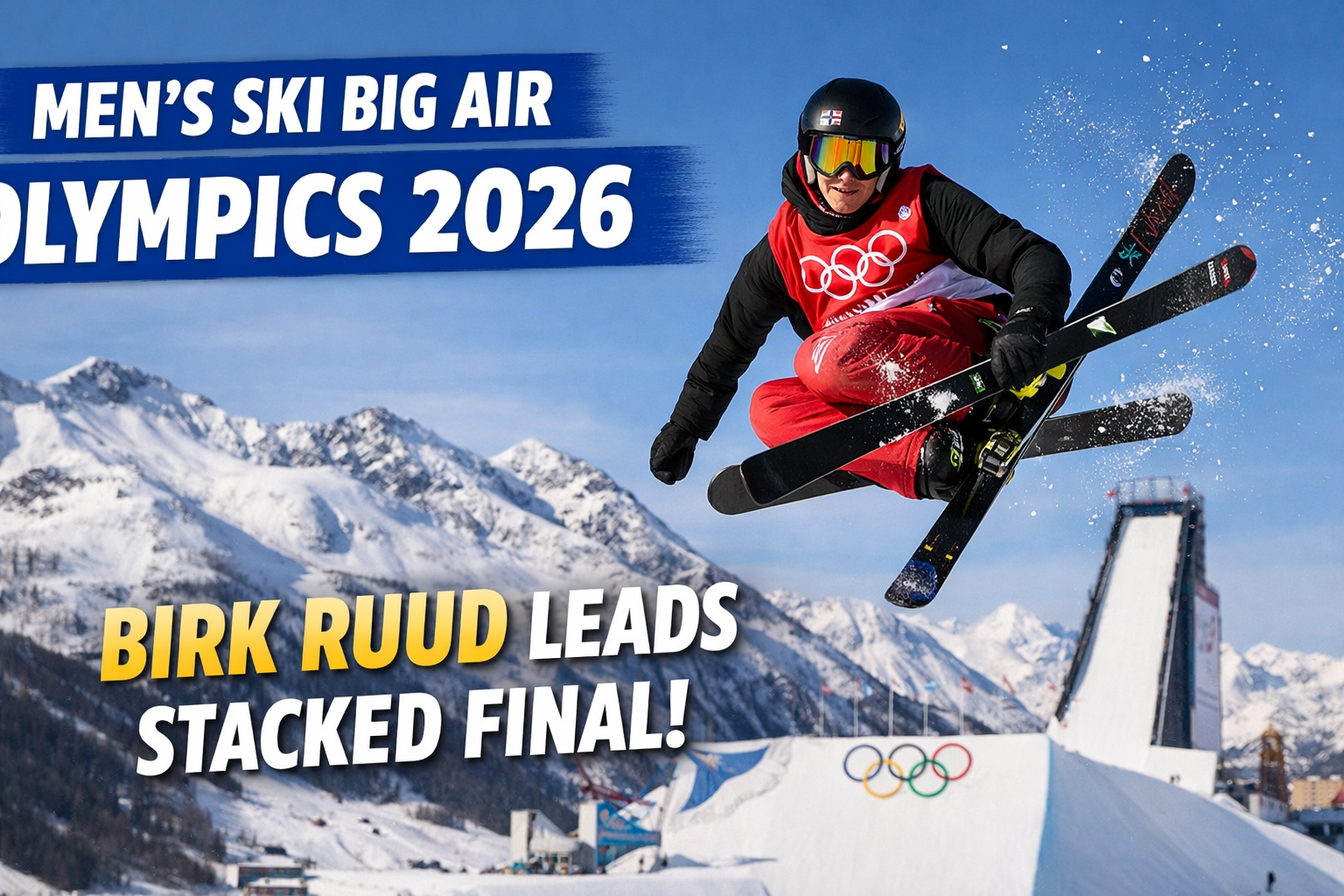

Men’s Ski Big Air Olympics 2026: Ruud Leads Stacked Final at Livigno Snow Park
The mens ski big air olympics 2026 final promises to be one of the most electrifying freestyle skiing contests in Winter Games history. Set against the dramatic alpine backdrop of Livigno Snow Park at Milano Cortina 2026, the event brings together Olympic champions, X Games winners, world champions, and rising stars ready to redefine what’s possible in the air.
Defending Olympic champion Birk Ruud headlines the field as he aims to capture his second Big Air gold medal. The Norwegian superstar, already an Olympic slopestyle champion, enters the final brimming with confidence after a composed qualification round that saw him finish third overall—without even using his third attempt.
But the path to gold in the men’s ski big air Olympics 2026 will be anything but easy.
Qualification Recap: A Battle of the Best
Qualification at Livigno Snow Park showcased the immense depth of talent in the field.
Topping the standings was reigning X Games champion Mac Forehand of the United States. Forehand delivered technical precision and amplitude, proving why he currently shares the Big Air World Cup lead with Ruud. His top score in qualification sent a clear message: he’s here for Olympic gold.
Second place went to Austria’s dynamic young star Matej Svancer, the Lausanne 2020 Youth Olympic champion. Svancer’s style and creativity make him one of the most exciting skiers in the competition. He is still chasing his first Olympic medal, but his qualification performance suggests that milestone could come sooner rather than later.
New Zealand’s reigning world champion Luca Harrington secured fifth place in qualification. Harrington has been remarkably consistent over the past two seasons and will be a serious podium threat in the men’s ski big air Olympics 2026 final.
Meanwhile, Ruud’s compatriot Tormod Frostad rebounded from an early fall to post the highest single-run score of the qualification round. His comeback under pressure demonstrated both resilience and technical excellence—two qualities essential in a high-stakes Olympic final.
And fans should not overlook Troy Podmilsak, the 2023 world champion and 2024 X Games champion. Podmilsak has built a reputation for delivering clutch performances when medals are on the line.
Ruud’s Evolution: From Freeski to Snowboard and Back
Birk Ruud’s journey to the men’s ski big air Olympics 2026 final has been anything but conventional. After achieving Olympic success, Ruud temporarily shifted focus to professional snowboarding. That crossover experience, he says, helped him rediscover his passion for freeskiing.
Snowboarding offered a fresh perspective—different movement patterns, new creative lines, and a renewed mental approach. Now back in ski competition, Ruud combines that inspiration with a sharpened psychological toolkit.
His strategy heading into Milano Cortina 2026 is simple but powerful: focus on execution, stay present, and embrace joy over pressure. It’s a mindset that has already delivered Olympic gold—and could do so again.
The Livigno Snow Park Challenge
Livigno Snow Park is expected to break new ground in the sport. The Big Air jump itself is massive, built for progression, amplitude, and innovation. But conditions have added an extra layer of complexity.
During the men’s slopestyle final earlier in the week, athletes faced what skiers call “flat light”—a visual phenomenon that eliminates shadows and makes depth perception difficult. According to Ruud, flat light makes it especially challenging to manage vision mid-air while spinning and flipping.
The rails at the top of the course are equally demanding—tall, long, and sharply zigzagged. American freestyle skier Alex Hall, who claimed silver in slopestyle, described it as “probably the hardest rail course” he and many others had ever skied.
Sweden’s Jesper Tjader, known for holding the world record for the longest rail ski, exemplified the resilience seen throughout the competition. After stumbling off a rail during his second slopestyle run, Tjäder refused to abandon it. Instead, he reclipped his boots and attacked the jumps, spinning and flipping with relentless creativity.
That spirit—pushing through mistakes, embracing risk, and skiing for joy—has defined Milano Cortina 2026 so far.
Joy Over Medals: The Freestyle Philosophy
While Olympic medals remain the ultimate prize, many athletes competing in the men’s ski big air Olympics 2026 emphasize something deeper: expression and fun.
Tjäder, who finished fifth in slopestyle, openly stated that medals are a bonus. His main goal is to showcase his skiing and land his best tricks on the sport’s biggest stage.
For Austrian standout Svancer, effort and innovation outweigh disappointment. Earlier this season at a World Cup event in Switzerland, his ski popped off at the top of a run—yet he still landed on one ski and placed second. That fearless creativity has become his trademark.
Norwegian skier Sebastian Schjerve, a three-time World Cup podium finisher, highlighted the strategic element of freestyle judging. Even after a mistake, skiers can salvage points in other scored sections. Sometimes a “throwaway” run becomes valuable practice—or an opportunity to entertain the crowd with something bold.
Even Ruud, after mathematically securing slopestyle gold before his final run, couldn’t resist pushing the limits. He turned his victory lap into another trick-filled descent—and face-planted off a rail. The crowd roared anyway. In freestyle skiing, joy is the point.
Who Has the Edge in the Men’s Ski Big Air Olympics 2026?
The final will likely come down to three critical elements:
- Technical Difficulty – Multiple off-axis spins exceeding 1800 degrees, combined with complex grabs and switch takeoffs.
- Amplitude – The size and height of the jump, a key scoring factor in Big Air.
- Execution Under Pressure – With only limited attempts, consistency is everything.
Ruud’s experience gives him a mental advantage. Forehand’s recent dominance makes him a statistical favorite. Svancer and Harrington bring explosive creativity. Podmilsak thrives in clutch situations. Frostad’s top single-run score in qualification proves he can outscore the field.
With such a stacked lineup, the men’s ski big air Olympics 2026 final could see multiple 95+ scores—and possibly tricks never before landed in Olympic competition.
The Bigger Picture: Progression at Milano Cortina 2026
The Milano Cortina Games have already demonstrated how far freestyle skiing has evolved. Courses are larger, tricks are more technical, and judging increasingly rewards innovation.
Athletes now train year-round, blending disciplines like snowboarding and freeskiing to expand their skill sets. The cross-pollination of styles—seen in Ruud’s snowboard detour—continues to push boundaries.
As the final approaches, one thing is certain: the men’s ski big air Olympics 2026 will not just crown a champion. It will showcase the future of freestyle skiing
Final Word
At Livigno Snow Park, medals matter—but expression defines the sport. Whether it’s Ruud defending his crown, Forehand asserting American dominance, or a rising star like Svancer claiming his first Olympic podium, the competition promises spectacle.
In an event built on height, spin, and fearless creativity, the men’s ski big air Olympics 2026 final could become one of the most iconic moments of the Winter Games.
And when the final run drops, expect history to be written—one trick at a time.


 By
By




 By
By