Shaheed Bhagat Singh Biography – The National Son of India
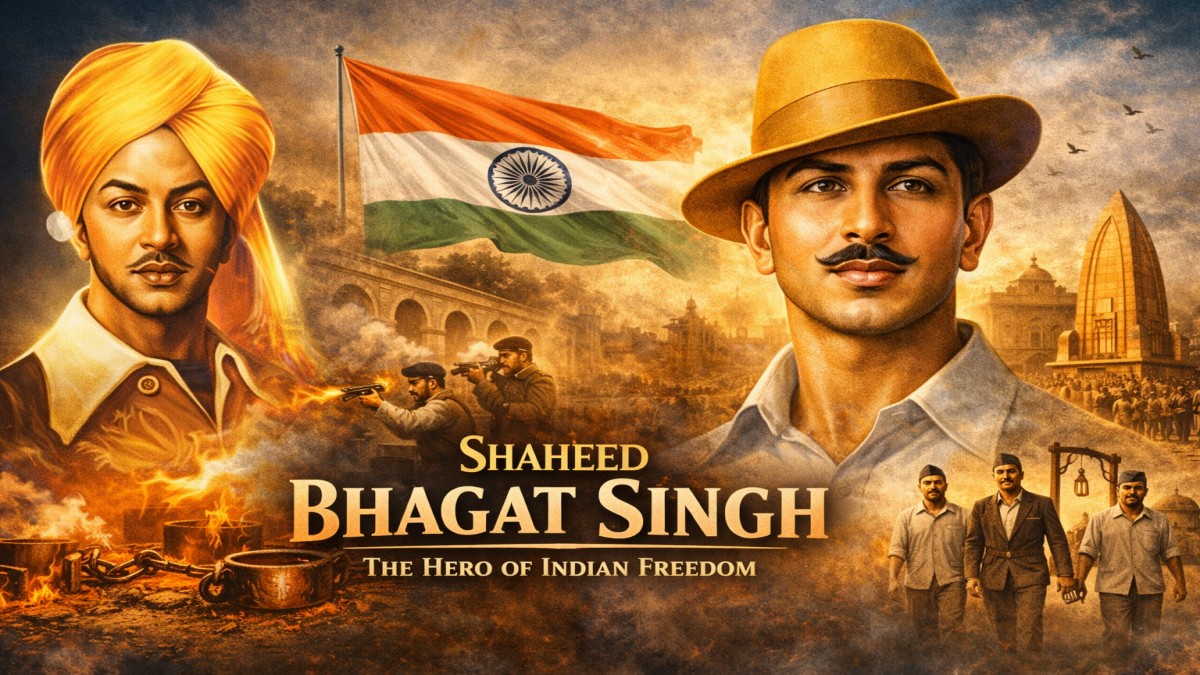
Shaheed Bhagat Singh remains one of the most iconic and revered revolutionaries in the history of India’s struggle for independence. His name is synonymous with courage, sacrifice, intellect, and an unwavering commitment to justice. Born during a time when India was under British colonial rule, Bhagat Singh rose as a fearless voice against oppression and became a symbol of youthful resistance. His life, though tragically short, left a profound and lasting impact on the Indian freedom movement and continues to inspire generations across the world.
Bhagat Singh was born on September 27, 1907, in Banga village of Lyallpur district, which is now located in present-day Pakistan. He was born into a Sikh family deeply involved in revolutionary activities against British rule. His father, Kishan Singh, and his uncles, Ajit Singh and Swaran Singh, were prominent figures in India’s freedom struggle. The environment in which he grew up was filled with patriotic fervor, discussions about independence, and stories of sacrifice. This early exposure to nationalist ideas played a crucial role in shaping his personality and ideological foundation.
Table of Contents
| Field | Details |
|---|---|
| Full Name | Bhagat Singh |
| Date of Birth | 27 September 1907 |
| Birthplace | Banga, Lyallpur (now Pakistan) |
| Father | Kishan Singh |
| Death | 23 March 1931 |
| Age | 23 Years |
As a child, Bhagat Singh was deeply influenced by stories of Sikh warriors and martyrs who had sacrificed their lives for righteousness and justice. These stories instilled in him a sense of duty and a burning desire to serve the nation. However, the turning point in his life came in 1919 when the Jallianwala Bagh massacre took place. The brutal killing of hundreds of innocent Indians by British troops left a deep scar on his young mind. It is believed that he visited the site shortly after the incident and collected soil soaked with the blood of martyrs, symbolizing his pledge to fight for India’s freedom.
During his school years, Bhagat Singh showed exceptional intelligence and a keen interest in reading. He was particularly drawn to political literature and revolutionary writings. He studied the works of both Indian leaders and international thinkers, including Karl Marx, Friedrich Engels, and Vladimir Lenin. These readings shaped his ideological perspective, leading him to embrace socialism and revolutionary activism as the path toward true freedom.
At a young age, Bhagat Singh actively participated in Mahatma Gandhi’s Non-Cooperation Movement in 1921. He boycotted British institutions, rejected foreign goods, and supported the call for self-reliance. However, when Gandhi abruptly withdrew the movement after the Chauri Chaura incident, Bhagat Singh felt disillusioned. He began to question the effectiveness of non-violence as the sole method of resistance and gradually turned toward revolutionary approaches.
By his teenage years, Bhagat Singh had made a firm decision to dedicate his life entirely to the nation. He rejected the idea of marriage and conventional career paths, choosing instead to join revolutionary organizations. His commitment was not impulsive but deeply thought-out, driven by a clear understanding of the sacrifices required for freedom.
Bhagat Singh joined the Hindustan Republican Association (HRA), which later evolved into the Hindustan Socialist Republican Association (HSRA). This organization aimed not only to overthrow British rule but also to establish a socialist society free from inequality and exploitation. Bhagat Singh played a significant role in reshaping the ideology of the organization, emphasizing the importance of social justice alongside political independence.
HSRA
| Objective | Description |
|---|---|
| Political Freedom | End British colonial rule in India |
| Social Equality | Remove class and caste discrimination |
| Economic Justice | Empower workers and peasants |
| Revolution | Use direct action to awaken masses |
One of the most significant events in Bhagat Singh’s revolutionary journey was the assassination of British officer John Saunders in 1928. This act was carried out to avenge the death of Lala Lajpat Rai, who had been injured during a protest against the Simon Commission. Although the intended target was James Scott, Saunders was mistakenly killed. This incident marked Bhagat Singh as one of the most wanted revolutionaries in India.
Despite being on the run, Bhagat Singh continued his revolutionary activities with unwavering determination. In 1929, he and Batukeshwar Dutt carried out a daring act by throwing non-lethal bombs in the Central Legislative Assembly in Delhi. The purpose of this act was not to cause harm but to protest against oppressive laws and to “make the deaf hear.” After the bombing, they did not attempt to escape but instead surrendered, using the trial as a platform to spread their message.
The trial of Bhagat Singh became a historic event. He used the courtroom as a stage to expose the injustices of British rule and to inspire the masses. His fearless attitude and powerful speeches turned him into a national hero. During his imprisonment, he also undertook a hunger strike demanding better treatment for political prisoners. This strike lasted for over 100 days and drew widespread attention and support from across the country.
Bhagat Singh was not only a revolutionary but also a thinker and writer. His essay “Why I Am an Atheist” reflects his rationalist philosophy and his belief in the power of human action over blind faith. He argued that true progress could only be achieved through reason, courage, and collective effort. His writings reveal a mature and insightful mind, far beyond his years.
Revolutionary Events
| Year | Event | Significance |
|---|---|---|
| 1919 | Jallianwala Bagh Massacre | Inspired revolutionary spirit |
| 1921 | Non-Cooperation Movement | Early political involvement |
| 1928 | Saunders Assassination | Revenge for Lala Lajpat Rai |
| 1929 | Assembly Bombing | Symbolic protest |
| 1931 | Execution | Martyrdom |
On March 23, 1931, Bhagat Singh, along with Rajguru and Sukhdev, was executed by the British government in Lahore Central Jail. The execution was carried out in secrecy, ahead of schedule, to prevent public unrest. He was only 23 years old at the time of his death. His martyrdom sparked widespread protests and made him an immortal symbol of resistance.
The legacy of Bhagat Singh extends far beyond his lifetime. He became a symbol of courage, sacrifice, and revolutionary thought. His ideas about socialism, equality, and justice continue to resonate in modern times. Numerous institutions, roads, and memorials have been named after him, ensuring that his memory remains alive.
Legacy & Honors
| Category | Details |
|---|---|
| Memorials | Hussainiwala Memorial, Museum |
| Institutions | Shaheed Bhagat Singh College |
| Cultural Impact | Films, books, songs |
| Recognition | National Hero of India |
In conclusion, Shaheed Bhagat Singh’s life is a testament to the power of conviction, courage, and sacrifice. He was not merely a freedom fighter but a visionary who dreamed of a just and equitable society. His actions were driven by a deep understanding of social and political realities, and his legacy continues to inspire millions. Even today, his voice echoes through history, reminding us that true freedom requires not only political independence but also social justice and equality.
Disclaimer
The information provided in this article about Shaheed Bhagat Singh is intended for educational and informational purposes only. While every effort has been made to ensure accuracy and authenticity, historical interpretations may vary based on different sources and perspectives.
This content does not intend to offend any individual, group, or community. All details are compiled from publicly available historical records and are presented with respect to India’s heritage and freedom struggle.
Readers are encouraged to verify facts from official or academic sources if required. The publisher will not be held responsible for any discrepancies, omissions, or consequences arising from the use of this information.
Frequently Asked Questions (FAQs)
1. Who was Bhagat Singh?
Bhagat Singh was a revolutionary freedom fighter of India who played a major role in the struggle against British colonial rule and became a symbol of courage and sacrifice.
2. What is Bhagat Singh’s date of birth and death?
Bhagat Singh was born on 27 September 1907 and was executed on 23 March 1931 at the age of 23.
3. Why is Bhagat Singh famous?
Bhagat Singh is famous for his revolutionary activities, including the Central Assembly bombing and the assassination of John Saunders, as well as his fearless sacrifice for India’s independence.
4. What was Bhagat Singh’s slogan?
His most famous slogan was “Inquilab Zindabad,” which means “Long Live the Revolution.”
5. What was the reason behind Bhagat Singh’s execution?
Bhagat Singh was executed for his involvement in the assassination of British officer John Saunders and his revolutionary actions against the British government.
6. What is Bhagat Singh’s ideology?
Bhagat Singh believed in socialism, equality, and revolution. He advocated for a society free from exploitation and injustice.
7. When is Bhagat Singh’s birthday celebrated?
Bhagat Singh’s birthday is celebrated on 27 September every year across India.
8. What is a short note on Bhagat Singh?
Bhagat Singh was a brave Indian revolutionary who sacrificed his life at a young age to fight against British rule and inspire future generations.
9. What is Bhagat Singh known for in Indian history?
He is known for his fearless actions, intellectual ideas, and ultimate sacrifice, which made him one of the greatest heroes of India’s independence movement.
10. How did Bhagat Singh inspire the youth?
Bhagat Singh inspired the youth through his courage, revolutionary ideas, and dedication to justice, encouraging them to stand against oppression.