





Pakistan vs Namibia: One Last Shot at Survival in Colombo
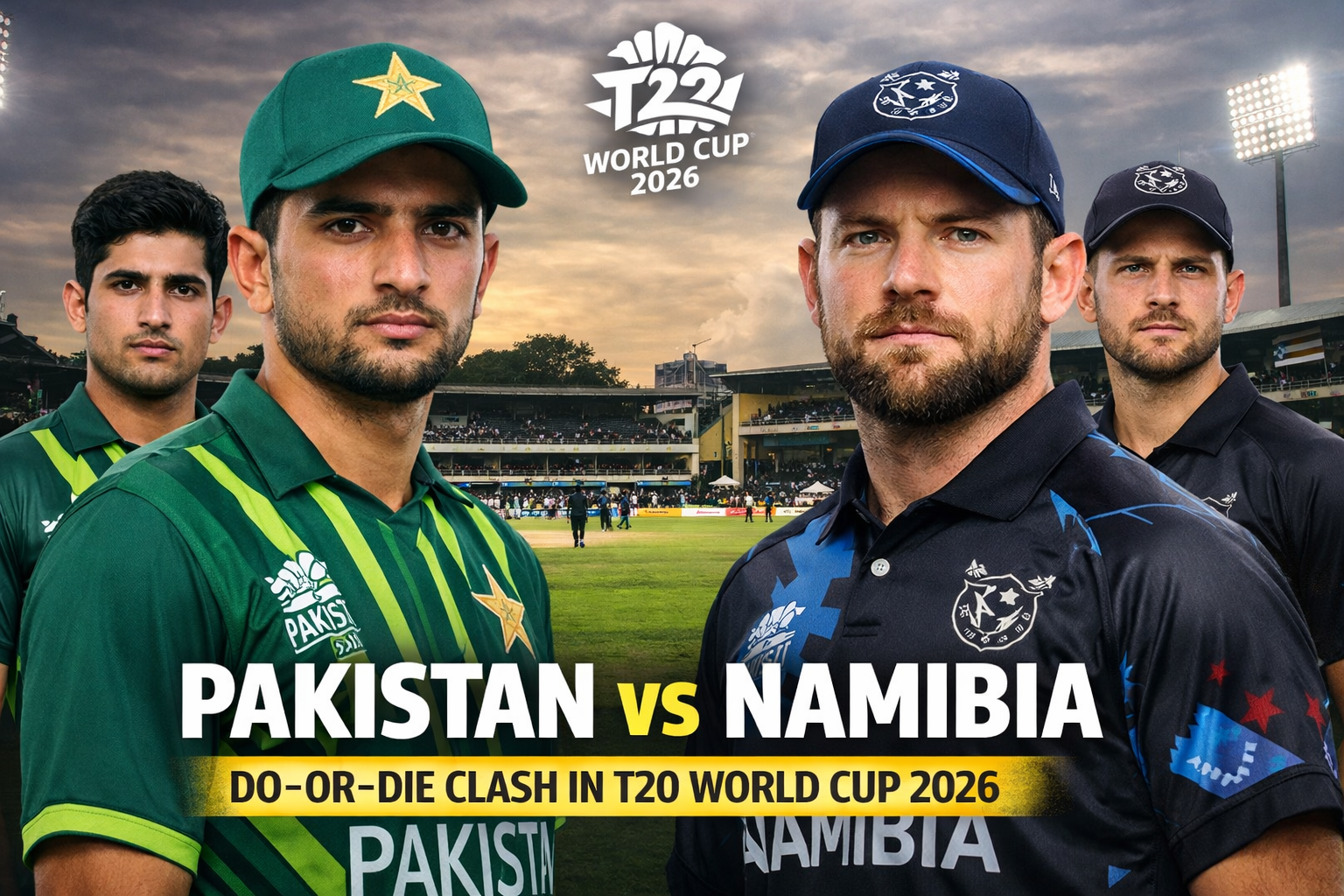
For Pakistan, it has come down to the simplest and most unforgiving equation: do not lose. When they walk out to face Namibia in their final Group A fixture, their entire T20 World Cup campaign will hinge on one performance, one afternoon, and perhaps even one over. Victory—or a rain-assisted no result—will book their place in the Super Eights. Defeat, however, would mark a third consecutive first-round exit at a men’s ICC tournament, a scenario unthinkable for a side of Pakistan’s pedigree.
The context could hardly be more tense. Pakistan arrived at this tournament speaking confidently about growth, depth, and evolution after the Asia Cup disappointment. Yet once again, familiar flaws have resurfaced at the worst possible moment. Their heavy defeat to India was not merely a loss; it was a reminder of patterns that refuse to fade, particularly under pressure.
Confidence Shaken, Questions Raised
The 61-run defeat against India cricket team exposed Pakistan across departments. With the bat, the top order crumbled almost immediately, leaving the middle order with too much to do and too little time. With the ball, Pakistan looked short of ideas and, more worryingly, short of penetration.
Senior figures found themselves under the harshest spotlight. Babar Azam, returning to the T20I side after missing the Asia Cup, again struggled against spin, an issue that has increasingly defined his recent T20 outings. His strike rate against spin since returning sits at just over 100, a glaring weakness in a format where momentum is everything.
Then there is Shaheen Afridi, Pakistan’s long-time strike bowler, whose struggles have been both surprising and concerning. Unable to control the PowerPlay or close out innings at the death, Shaheen has looked a step off his best, conceding runs without the compensating wickets that once made him indispensable.
The criticism that followed was swift and loud. For the first time in years, the idea of benching both Babar and Shaheen no longer feels radical—it feels plausible.
Namibia: Playing for Pride, Not Pressure
While Pakistan fight for survival, Namibia cricket team enter the contest already eliminated. Yet that may be precisely what makes them dangerous. With no qualification pressure and nothing to lose, Namibia can afford to play with freedom—something Pakistan desperately lacks right now.
Namibia’s tournament has been defined by near-misses rather than no-shows. They have often started well, particularly with the bat, only to fade in the middle and death overs. Captain Gerhard Erasmus has struggled for runs, and the dip in form of pace spearhead Ruben Trumpelmann has hurt their early breakthroughs. Trumpelmann has managed just one wicket across three matches, a stark contrast to his usual impact with the new ball.
Still, Namibia’s top order has shown enough spark to suggest they could rattle Pakistan if given an opening. An early flurry of boundaries or a couple of quick wickets could quickly turn anxiety into panic.
The Venue and Conditions
The match will be played at the Sinhalese Sports Club, a venue that has already produced one high-scoring thriller in this tournament. Ireland’s 235 against Oman on the same surface underlined its batting-friendly nature, aided by a smaller playing area and a pitch positioned off-centre on the square.
Compared to the R Premadasa Cricket Stadium, the SSC wicket offers slightly more assistance to seamers, particularly early on, but once batters are set, scoring becomes fluent. Overcast conditions and the threat of passing showers add another variable, especially for a Pakistan side that would gladly accept a washout if it guarantees qualification.
Selection Dilemmas for Pakistan
The defeat against India has all but guaranteed changes. Fast bowlers Naseem Shah and Salman Mirza are pushing strongly for inclusion, offering more pace and aggression than Pakistan displayed in their previous outing. There is also growing talk of fresh faces in the batting order, with Fakhar Zaman and Khawaja Nafay both in contention.
The biggest calls, however, revolve around Babar and Shaheen. Dropping either would be a bold statement; dropping both would signal a clear shift towards short-term results over reputation. Pakistan’s management must decide whether experience is the solution to a crisis—or part of the problem.
What is certain is that Pakistan cannot afford another timid start with the bat or another one-dimensional bowling plan. Namibia may not possess India’s firepower, but complacency would be fatal.
Key Battles to Watch
One player who could define Pakistan’s fate is Saim Ayub. Highly rated and immensely talented, Ayub has yet to produce a defining T20 World Cup innings. Against Namibia, Pakistan need more than a cameo—they need assurance at the top, someone willing to bat through the PowerPlay and settle the nerves.
For Namibia, opener Louren Steenkamp looms large. Fearless and aggressive, Steenkamp has shown he can take on quality bowling, and his ability to score quickly early could put Pakistan under immediate stress.
What’s at Stake
For Pakistan, the implications stretch far beyond this match. Qualification would keep their campaign alive and offer a chance at redemption in the Super Eights. Failure would trigger searching questions about direction, leadership, and the future of several senior players.
For Namibia, the result may not change the standings, but the experience matters. As co-hosts of the 2027 ODI World Cup, every competitive performance against top-tier opposition is an investment in the future.
Final Word
On paper, Pakistan should win comfortably. In reality, tournaments are not decided on paper. Frayed confidence, selection uncertainty, and the weight of expectation can make even straightforward matches feel like minefields. Namibia, free of pressure and eager to finish on a high, will sense that vulnerability.
For Pakistan, there is no room left for excuses. No talk of rebuilding, no margin for error. Just one goal remains—do not lose.

 By
By




 By
By