


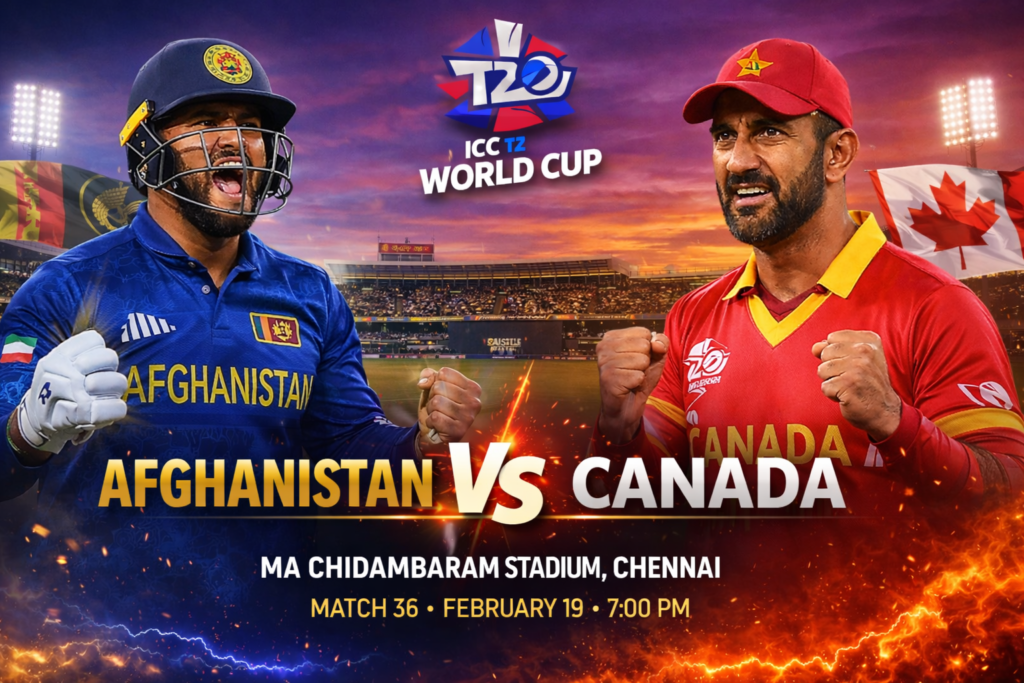
Afghanistan vs Canada: End of a Cycle or Start of a New Era?
Dead rubbers used to be unfamiliar territory for Afghanistan. Not long ago, they were the underdogs fighting for recognition, every fixture a statement of intent. But in recent years, Afghanistan have redefined themselves as giant-slayers on the global stage. Wins over England, Pakistan, Sri Lanka, and the Netherlands in the 2023 ODI World Cup signaled their arrival as a serious force. Their remarkable run to the semi-finals of the 2024 T20 World Cup — highlighted by victories against New Zealand, Australia, and Bangladesh — confirmed it was no fluke.
Now, as they prepare to face Canada in what has become an inconsequential Group D fixture at the 2026 T20 World Cup in Chennai, the narrative feels different. Instead of chasing qualification scenarios, Afghanistan are confronting something more personal: the possibility of a generational transition.
A Campaign That Promised More
Afghanistan entered this tournament in what many dubbed the “group of death,” alongside South Africa and New Zealand. The equation was simple but brutal — win at least one of those marquee clashes to stay in contention. Instead, they suffered narrow defeats that effectively derailed their Super Eights ambitions.
The loss to South Africa was particularly agonizing. After two Super Overs, Afghanistan’s campaign hung by a thread. Rahmanullah Gurbaz, inches away from pushing the contest into a third Super Over, mistimed a crucial yorker and perished. His reaction — frustration etched in every movement — captured the heartbreak of a team that knew how close they had come.
Against New Zealand, Afghanistan’s famed spin attack couldn’t exert its usual chokehold. Rashid Khan sparkled in patches, Mujeeb Ur Rahman had his moments, but collectively the spin quartet lacked the sustained dominance that once defined Afghanistan’s T20 identity. Noor Ahmad endured a difficult tournament, while veteran Mohammad Nabi found himself playing a limited role with both bat and ball.
For a side built around spin supremacy, that dip in impact raised uncomfortable questions.
The Nabi Question
At 41, Mohammad Nabi remains one of Afghanistan’s most influential cricketers — a pioneer who has shepherded Afghan cricket from obscurity to global respectability. He is just 52 runs shy of 2500 T20I runs, a milestone that would further cement his legacy.
Yet, the signs of transition are hard to ignore. Nabi recently shared the field with his son in a Bangladesh Premier League match — a poetic moment that underscored the passage of time. Within the Afghan setup, younger all-rounders like Azmatullah Omarzai are already taking on greater responsibility. Omarzai’s rescue act against UAE earlier in the tournament highlighted that Afghanistan’s future might already be here.
Rashid Khan, when asked about potential retirements, maintained that no player has formally communicated plans to step away. But transitions in sport rarely announce themselves with formal declarations. Sometimes, they unfold subtly — in reduced roles, in tactical adjustments, in shifting expectations.
The Canada fixture could serve as a symbolic farewell to an era, or simply a reminder that Afghanistan’s veterans still have one more push left in them.
Gurbaz and the Weight of Expectation
Rahmanullah Gurbaz has evolved into Afghanistan’s batting talisman. Aggressive, fearless, and capable of dismantling top-tier attacks, he embodies the modern Afghan cricketer — confident and unapologetically ambitious.
Yet, the narrow margins at the highest level can define careers. His dismissal in the second Super Over against South Africa will linger. For a young batter, bouncing back from such heartbreak is part of the maturation process.
A strong performance against Canada could help him reset mentally. Afghanistan’s batting has often revolved around early momentum, and when Gurbaz fires, the entire lineup plays with greater freedom.
Canada’s Quiet Rise
While Afghanistan reflect on what might have been, Canada approach this game with different motivations. They may be eliminated, but they have left an impression.
Nineteen-year-old Yuvraj Samra has been the breakout star of their campaign. His strokeplay against New Zealand — even in defeat — hinted at a talent capable of thriving beyond associate cricket’s usual confines. Canada’s challenge now is to convert promise into consistent progress.
Navneet Dhaliwal’s retirement adds emotional weight to this fixture. The former captain has been instrumental in Canada’s resurgence, guiding them to their first T20 World Cup qualification in 2024. He leaves as their highest scorer in T20Is — a testament to his longevity and leadership.
For Dhaliwal, this final outing represents both closure and celebration. For Canada, it marks the end of one leadership cycle and the potential start of another built around emerging names like Samra and Dilpreet Bajwa.
Tactical Outlook: Spin vs Structure
The conditions in Chennai have defied pre-tournament predictions. Traditionally known for aiding spinners, the Chepauk surface has offered consistent bounce and value for strokes. Batters have flourished, and totals once considered competitive have been chased down with authority.
An evening start introduces the dew factor, potentially influencing captains to bowl first. However, dew hasn’t always been decisive in this tournament, making toss decisions less straightforward than usual.
Afghanistan’s probable XI suggests continuity, though fringe players like Abdullah Ahmadzai could get opportunities. Canada, similarly freed from qualification pressure, might experiment with combinations, especially in the bowling department where inconsistency has cost them.
Canada’s attack struggled to defend early advantages against New Zealand, highlighting the gulf between associate and full-member depth. Afghanistan, despite their elimination, remain a more balanced unit on paper — particularly if their spin trio clicks in tandem.
Numbers That Surprise
One intriguing statistic from this tournament is Afghanistan’s batting average of 24, marginally better than Canada’s 23.73. Both figures eclipse those of England, Pakistan, India, and Australia in this edition — a reminder that T20 cricket’s unpredictability spares no one.
Such numbers illustrate how competitive Afghanistan have been, even in defeat. Margins have been slim. Execution under pressure — particularly in death overs — has been the separating factor.
Beyond the Scorecard
More than points or pride, this game symbolizes the evolving landscape of international cricket.
Afghanistan are no longer content with participation. Their baseline expectation is competitiveness against elite opposition. Failure to advance from a tough group stings precisely because their standards have risen.
Canada, meanwhile, continue to chip away at the sport’s traditional hierarchy. Their ability to push established teams, unearth young talent, and compete on global platforms reflects cricket’s expanding footprint.
Both sides, in different ways, embody transition — Afghanistan potentially shifting from their founding generation to a new core, Canada moving from hopeful qualifiers to consistent contenders.
The Human Element
Rashid Khan’s tribute to departing head coach Jonathan Trott underscored the human side of this campaign. Trott’s tenure coincided with Afghanistan’s tactical evolution — improved batting discipline, clearer role definitions, and greater composure in high-pressure scenarios.
Leadership changes, like player transitions, often reshape team identities. Afghanistan’s next chapter will depend not only on personnel but on how effectively they sustain the cultural and tactical gains of recent years.
Dhaliwal’s reflections on his proudest moments — qualifying for the World Cup, scoring in the opening game, captaining his nation — serve as reminders that international cricket’s emotional currency often outweighs statistical milestones.
A Match That Still Matters
On paper, Afghanistan vs Canada might lack tournament stakes. In reality, it carries narrative significance.
For Afghanistan, it’s an opportunity to finish strong, reassert their brand of cricket, and perhaps give clarity to looming questions about the future. For veterans like Nabi, it could be another chapter in a storied career — or a quiet prelude to farewell.
For Canada, it’s a final chance to secure a win, validate their progress, and send off Dhaliwal with a performance worthy of his contributions.
Dead rubbers may once have been alien to Afghanistan. Now, they approach one with a different kind of urgency — not for qualification, but for identity.
As the lights shine over Chennai, the contest may not alter the tournament table. But it could signal something equally significant: the closing of one era and the tentative dawn of another.