


Oakland’s Alysa Liu Wins Historic Olympic Gold in Women’s Figure Skating at Milano Cortina 2026
In a moment that will echo through Olympic history and the city streets of Northern California alike, Alysa Liu captured the gold medal in women’s singles figure skating at the 2026 Winter Olympics.
At just 20 years old, the Oakland native delivered a breathtaking free skate in Milan, ending a 24-year drought for American women in Olympic figure skating. Not since 2002 had a U.S. woman stood atop the Olympic podium in this event. On Thursday night, under the bright lights of Milano Cortina, Liu changed that narrative forever.
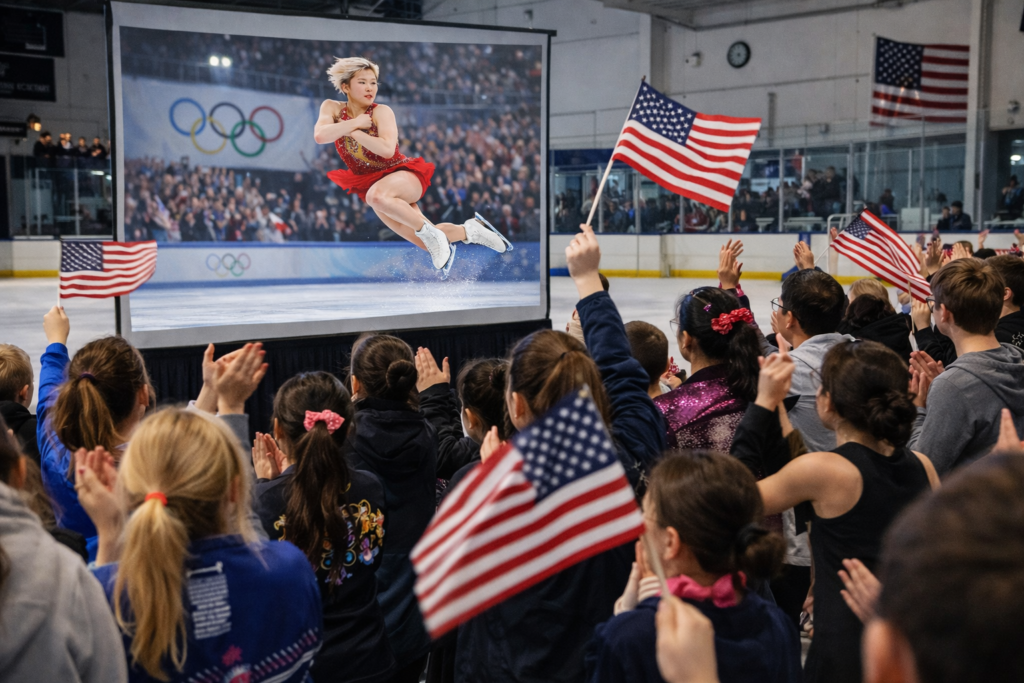
Back home in California, inside the rink where she first laced up her skates at age five, cheers erupted. The Oakland Ice Center—her childhood training ground—became the epicenter of celebration as friends, coaches, young skaters, and longtime supporters witnessed history together.
This was more than a medal. It was a comeback story, a hometown triumph, and a defining moment for American figure skating.
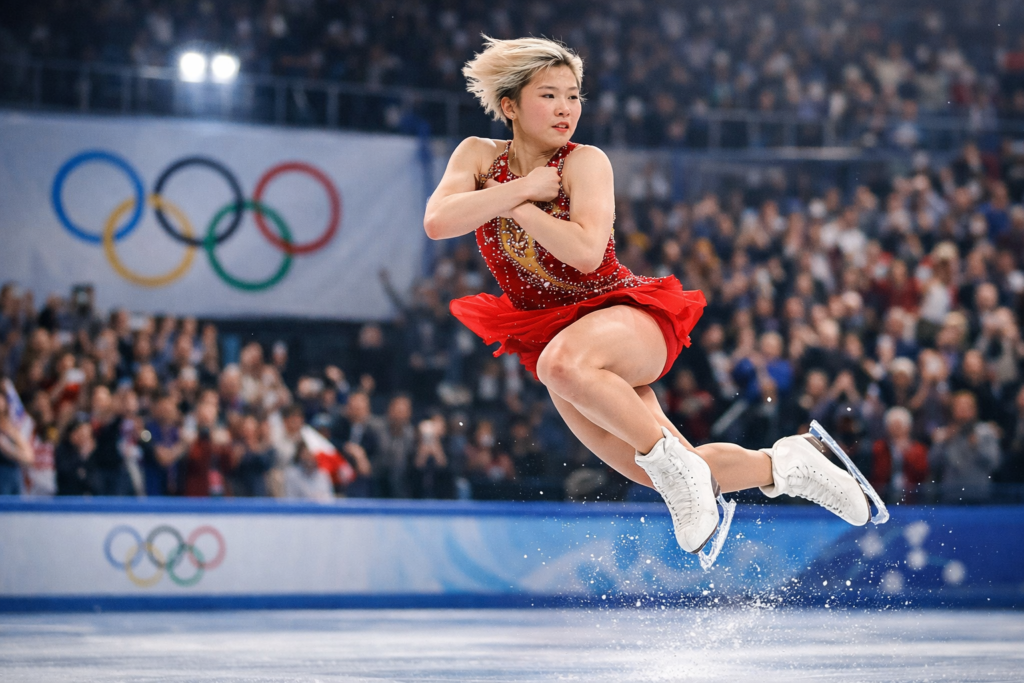
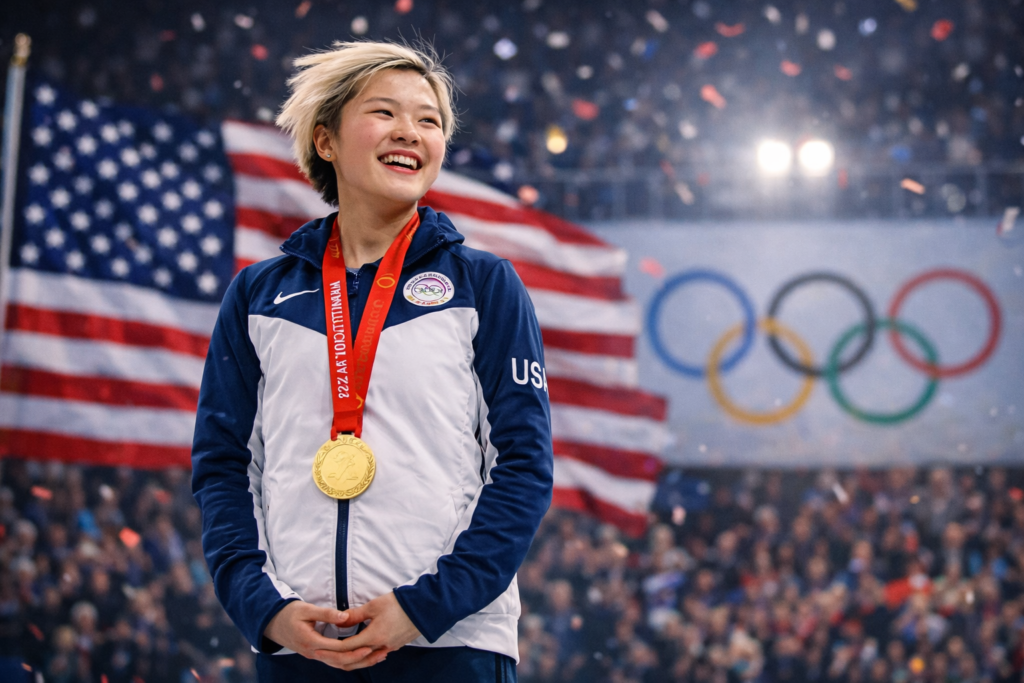
Image Credit: AI-generated depiction of Alysa Liu at the 2026 Winter Olympics, created using OpenAI image generation tools for editorial illustration.
- Oakland’s Alysa Liu Wins Historic Olympic Gold in Women’s Figure Skating at Milano Cortina 2026
- A Golden Performance on the World Stage
- Oakland’s Watch Party: Pride in Real Time
- From Child Prodigy to Olympic Champion
- A Comeback on Her Terms
- More Than a Medal
- Team USA’s Breakthrough Moment
- The Global Olympic Atmosphere
- Oakland’s Ambassador
- Mental Health and the Modern Athlete
- Technical Brilliance Meets Artistic Maturity
- A 24-Year Wait Ends
- The Road Ahead
- A Moment Bigger Than Skating
- FAQ Section
A Golden Performance on the World Stage
Heading into the free skate, few predicted that Liu would end the American gold medal drought. Japan’s formidable duo—Kaori Sakamoto and rising star Ami Nakai—occupied the top two spots after the short program.
But figure skating is a sport where momentum shifts in minutes.
Skating to Donna Summer’s iconic “MacArthur Park Suite,” Liu opened with a confident triple flip, followed by a flawless triple lutz–triple toe loop combination. Her jumps soared, her landings were clean, and her artistry captivated the arena. The crowd clapped along to the disco rhythm as she moved across the ice with unmistakable command.
When she struck her final pose, the roar inside the arena was deafening. As she skated off, adrenaline still surging, Liu turned toward the camera and let her emotions spill out in celebration.
Her score: 150.20 in the free skate—a personal season best.
Her total: 226.79—enough to secure the lead with only two skaters remaining.
When Sakamoto ultimately earned silver and Nakai bronze, the gold was Liu’s.
Twenty-four years after America’s last Olympic champion in women’s singles, the drought was over.
Oakland’s Watch Party: Pride in Real Time
Thousands of miles away, the energy inside the Oakland Ice Center felt just as electric.
Families packed the viewing area. Young skaters stood shoulder-to-shoulder in team jackets. Coaches who once corrected Liu’s earliest edges watched with misty eyes.
Glenn Martin, the center’s general manager, recalled how people would crowd around whenever word spread that Liu was practicing.
“When people started realizing Alysa was in the building, they would start coming over here and watching,” he said.
For many there, this victory felt personal.
Eight-year-old Charlotte Murphy proudly displayed an autograph Liu had given her weeks earlier. “I love her personality,” she said. “She’s kind. I want to be just like her in the Olympics.”
Hannah Kupiloff, a UC Berkeley student and skater recovering from injuries, described Liu as inspirational. “You fall all the time in skating. It gets you down. But she just keeps pushing.”
That resilience defined Liu’s Olympic journey.
From Child Prodigy to Olympic Champion
Liu’s rise began early.
In 2019, at just 13 years old, she became the youngest woman in U.S. history to win the national championship. She repeated the feat the following year. By 16, she was representing Team USA at the Beijing Olympics in 2022.
But despite her early success, burnout loomed.
After finishing sixth in Beijing and earning bronze at the world championships that season, Liu shocked the skating world by announcing her retirement. She cited exhaustion and a need to rediscover balance.
For two years, she stepped away.
She traveled. She enrolled at UCLA. She lived like a normal teenager.
Then, unexpectedly, the ice called her back.
A family ski trip rekindled her love for gliding on frozen surfaces. Soon after, she found herself at a public skating session. The spark was unmistakable.
She returned—not as a prodigy chasing expectations, but as an athlete reclaiming joy.
Image Credit: AI-generated depiction of Alysa Liu at the 2026 Winter Olympics, created using OpenAI image generation tools for editorial illustration.
A Comeback on Her Terms
When Liu announced her comeback, she made one thing clear: this time, it would be different.
She would choose her music.
She would design her costumes.
She would determine her training schedule.
Her creativity and voice would lead the way.
Under coaches Phillip DiGuglielmo and Massimo Scali, she rebuilt patiently. Few athletes successfully return after a multi-year retirement, especially in figure skating. But Liu’s renewed mindset changed everything.
Last season, she captured the world championship title. Yet even then, gold medals weren’t her stated goal.
Her focus? Expression. Art. Experience.
Going into the 2026 Olympics, her team didn’t frame the season around winning. Their primary objective was simply making the Olympic team.
Winning gold was never the spoken ambition.
And perhaps that freedom unlocked her brilliance.
More Than a Medal
After her score confirmed gold, Liu’s reaction revealed her priorities.
“I don’t need this medal,” she said later. “What I needed was the stage.”
She clapped and cheered for Sakamoto and Nakai as they skated. She hugged competitors afterward. She celebrated teammates.
It wasn’t just sportsmanship—it was perspective.
For Liu, the journey mattered more than the hardware.
Her coach later revealed they toasted before the free skate, already celebrating her return to the Olympic stage regardless of placement.
That mindset—unburdened by pressure—may have been the difference.
Team USA’s Breakthrough Moment
Liu’s triumph wasn’t isolated.
She had already secured a gold medal earlier in the Games as part of the team event. Alongside teammates like Amber Glenn and Isabeau Levito, she helped elevate American women’s skating back into global prominence.
Glenn delivered a powerful free skate redemption performance, while Levito fought through adversity.
But on this night, it was Liu who stood tallest.
Her victory signaled a renaissance for U.S. women’s figure skating—a sport long dominated by Russian and Japanese athletes in recent cycles.
Now, America was back on top.
The Global Olympic Atmosphere
While Liu’s gold captured headlines, the broader Olympic stage buzzed with intensity.
The men’s hockey semifinals featured Canada vs. Finland and USA vs. Slovakia, renewing debates about a potential North American gold medal showdown.
Freestyle skiing finals, biathlon mass starts, speedskating medal races, and curling semifinals filled the schedule.
But in a Games packed with drama, Liu’s free skate became one of its defining moments.
Her performance embodied what the Olympics represent: artistry, resilience, reinvention, and national pride.
Oakland’s Ambassador
Back in California, friends described Liu as approachable, warm, and deeply connected to her roots.
Scarlet Simon, coordinator of the rink’s Learn to Skate program, recalled how Liu once participated as a young student. Now, she inspires the next generation.
“She truly loves this sport,” Simon said. “There’s just no one like her.”
A customized San Jose Sharks jersey bearing Liu’s name awaits her return home.
For Oakland—a city fiercely proud of its identity—this victory amplifies civic pride.
“Alysa is such an ambassador for the city,” one supporter said.
And in many ways, she represents something broader: the idea that global excellence can emerge from local rinks.
Mental Health and the Modern Athlete
Liu’s journey also resonates beyond medals.
Her decision to step away from skating at 16—during what many considered the peak of her career—highlighted the pressures elite athletes face.
In recent years, athletes across sports have prioritized mental health. Liu joins that growing movement.
Her comeback reinforces a powerful message: stepping back does not mean giving up. It can mean rebuilding.
Amber Glenn echoed that sentiment, noting that Liu’s story shows the skating community that taking time for oneself is acceptable.
For young athletes watching worldwide, that lesson may be as important as any jump combination.
Technical Brilliance Meets Artistic Maturity
Technically, Liu’s free skate displayed remarkable precision.
Her jump entries were smooth. Her rotations tight. Her landings controlled. Judges rewarded her Grade of Execution and Program Component Scores.
But what separated her from competitors wasn’t just technical consistency—it was maturity.
Her interpretation of “MacArthur Park Suite” combined athletic explosiveness with musical nuance. She transitioned seamlessly between power and grace.
The performance felt complete.
Not rushed.
Not forced.
Not pressured.
Just authentic.
A 24-Year Wait Ends
The last time an American woman won Olympic gold in figure skating, the sport looked very different.
Scoring systems have evolved. Technical difficulty has increased. Global competition has intensified.
Ending a 24-year drought required more than talent—it required transformation.
Liu represents that evolution.
She bridges eras: a child prodigy shaped by modern athletic expectations, and a mature performer guided by self-awareness.
Her gold medal is both a culmination and a beginning.
The Road Ahead
What comes next?
For now, celebration.
But her victory reshapes the competitive landscape heading into future world championships and international events.
Young American skaters now train with tangible belief that Olympic gold is attainable again.
Oakland Ice Center will likely see a surge in enrollment.
And Liu—still only 20—may just be entering her prime.
A Moment Bigger Than Skating
When Liu embraced Sakamoto and Nakai after the final scores, the image symbolized Olympic unity.
Competition fierce.
Respect unwavering.
Joy shared.
In Milan, she delivered a flawless routine.
In Oakland, she inspired a generation.
Across the United States, she reignited belief in a sport that had waited nearly a quarter-century for this moment.
Alysa Liu didn’t just win gold.
She reclaimed the Olympic stage for American women.
She honored her community.
She redefined resilience.
And she reminded the world that sometimes, stepping away is exactly what allows you to soar higher than ever before.
FAQ Section
Q1: How old is Alysa Liu?
Alysa Liu is 20 years old and won Olympic gold at the 2026 Winter Games.
Q2: When was the last time a U.S. woman won Olympic gold in figure skating?
Before Alysa Liu’s win in 2026, the last American woman to win was in 2002.
Q3: Where did Alysa Liu train?
She trained at Oakland Ice Center in California.
Q4: Did Alysa Liu retire before winning Olympic gold?
Yes, she retired in 2022 and returned two years later before winning gold in 2026.
Disclaimer: This content is for informational purposes only. Some images may be AI-generated for illustrative use.