

Alysa Liu’s Golden Halo: How Style, Self-Belief, and Skill Crowned a New Olympic Queen
When Alysa Liu stepped onto the ice at the Milano Cortina 2026 Winter Games, she carried more than choreography and technical difficulty into her free skate. She carried expectation, history, and a quiet but unmistakable confidence.
By the end of the night, she had rewritten American figure skating history — becoming the first U.S. woman in over two decades to capture Olympic gold in women’s free skating. The achievement instantly placed her in the lineage of American champions, reviving a golden chapter that had been dormant since 2002.
But Liu’s victory was about more than medals and scores. It was about identity. It was about expression. It was about skating into the spotlight exactly as she wanted to be seen — halo hair gleaming under arena lights, a fearless smile flashing, and a belief in herself that radiated far beyond the rink.
“I feel good, I feel confident, and I put it all out there,” she said afterward — a statement that perfectly summarized both her skate and her journey.
Breaking a 24-Year American Drought
The Weight of History
For American women in figure skating, Olympic gold had become elusive. The last time a U.S. woman stood atop the Olympic podium in women’s singles was at the 2002 Winter Games.
That changed in Milano Cortina.
Liu’s performance wasn’t just technically impressive — it was controlled, mature, and emotionally resonant. Judges rewarded her consistency, her transitions, and her artistry. But perhaps most importantly, they rewarded her composure under pressure.
She didn’t skate defensively. She skated boldly.
And in doing so, she shifted the narrative of American women’s figure skating from rebuilding to reigning.
The Crown Before the Crown: The Rise of “Halo Hair”
More Than a Hairstyle — A Statement
Before she officially earned her gold medal, Liu had already crowned herself — literally.
Her now-famous “halo hair” became one of the most talked-about visual signatures of the Games. The design features horizontal brunette stripes layered with lighter rings in a milk-tea platinum tone, separated by bright blonde transitions.
The result? A pattern resembling tree rings — or halos encircling her head.
She had revived and refined the look, describing it playfully online as “revived halos,” but the symbolism ran deeper. Rings stacked year after year mirrored growth. Experience. Evolution.
And, unintentionally or not, they also hinted at Olympic rings — a connection that fans quickly embraced.

The Evolution of the Tree-Ring Look
Liu first began experimenting with the ringed hairstyle in 2023. Each year, she added a new stripe — a ritual marking time and progress.
She has explained that she plans to continue adding one ring each winter. The concept is simple:
- One ring per year
- One layer of growth
- One more season of experience
At the time of her Olympic triumph, three rings adorned her hair.
Soon, there could be five — the same number that represent the Olympic Games.
Hair Color Transformation
Originally, her rings leaned toward a warm ginger hue. For the Olympic season, she wanted something different. Lighter. Brighter. More platinum.
The result was a shift toward a soft milk-tea tone — a creamy blonde that stood out under arena lights while still complementing her natural brunette base.
The technical challenge of lifting hair color evenly across circular bands is significant. Achieving platinum tones requires precision bleaching, toning, and careful blending to avoid harsh lines. Yet her final look appeared seamless.
It wasn’t accidental. It was intentional — much like her skating.
Style as Competitive Armor
Confidence You Can See
Athletes often speak about “feeling ready.” For Liu, readiness extended to aesthetics.
Her halo hair wasn’t just creative flair. It was psychological armor.
In high-performance sport, identity can be grounding. When athletes feel authentically themselves, they compete freer. Less restricted. Less anxious.
Liu skated not as a generic competitor in a field of elite athletes — she skated as Alysa Liu.
That distinction matters.
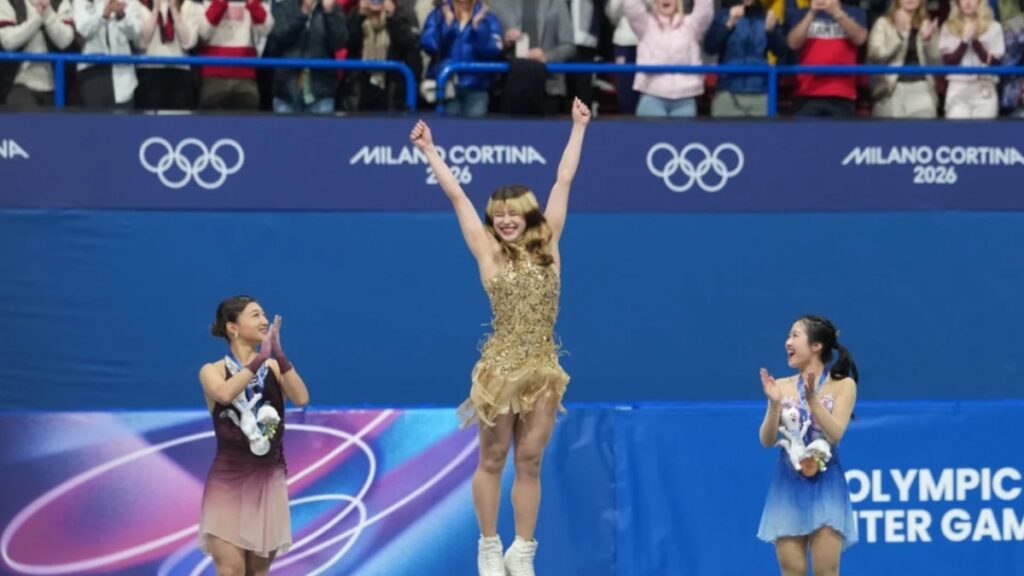
Podium Moments: Gold, Silver, Bronze
The medal ceremony brought together three exceptional skaters:
- 🥇 Alysa Liu – Gold (USA)
- 🥈 Kaori Sakamoto – Silver (Japan)
- 🥉 Ami Nakai – Bronze (Japan)
Japan’s continued dominance in women’s figure skating remained evident, but this podium signaled renewed American resurgence.
Below is a professional HTML table summarizing medal results:
| Position | Athlete | Country | Medal |
|---|---|---|---|
| 1st | Alysa Liu | United States | Gold |
| 2nd | Kaori Sakamoto | Japan | Silver |
| 3rd | Ami Nakai | Japan | Bronze |
The “Smiley” Piercing: Fearless Individuality
If you looked closely during medal photos, you might have noticed another ring — this time inside her smile.
Liu wears what is known as a “smiley” piercing, placed through the frenulum — the thin tissue between the upper lip and gum. It becomes visible when she grins.
It’s subtle. But striking.
And fitting.
The piercing mirrors the same boldness reflected in her hair and skating style. It signals independence. Ownership. A refusal to blend in.
In a sport historically associated with uniformity and traditional presentation, Liu embraces modern individuality without apology.
Milano Cortina 2026: A Stage Worthy of a Star
The women’s free skating event unfolded at the Milano Ice Skating Arena during the 2026 Winter Olympics.
The setting amplified the drama:
- Bright white ice
- Packed grandstands
- Olympic banners cascading from rafters
- A global audience watching in real time
The Olympic Games demand not just skill, but nerve. Free skating is the ultimate test — a culmination of technical content and artistic interpretation.
Liu delivered both.
Olympic Beauty Trends: Expression Beyond Sport
Liu wasn’t the only Olympian using beauty as storytelling.
Across the Winter Games, athletes showcased creative nail art, bold manicures, and symbolic designs.
Silver medalist Eileen Gu displayed Olympic ring-inspired nail designs.
Dutch speed skater Jutta Leerdam showcased manicures featuring white rings after her gold-medal win.
Danish curler Jasmin Holtermann also sported Olympic-themed nail art during competition.
Why Beauty Matters in Elite Sport
Athletes increasingly use aesthetics to:
- Express identity
- Celebrate culture
- Boost confidence
- Inspire younger fans
This blending of sport and self-expression reflects a generational shift.
Psychological Edge: Self-Belief as a Performance Tool
Elite figure skating is 50% physical preparation and 50% mental resilience.
Liu’s self-confidence was evident in her post-skate remarks. She emphasized feeling good and putting everything out there.
That mindset is crucial in free skating, where:
- One fall can derail momentum
- One under-rotation can impact scoring
- One hesitation can affect flow
Confidence stabilizes execution.
It allows athletes to attack elements instead of surviving them.
Technical Overview: What Makes a Gold Medal Free Skate?
While final scores reflect detailed judging criteria, Olympic-level free skating generally requires:
- Multiple triple or quad jumps
- Clean combinations
- Complex step sequences
- Seamless transitions
- Strong skating skills
- Artistic interpretation
Liu’s program demonstrated balance — power without sacrificing elegance.
Below is a simplified HTML overview of typical judging categories:
| Component | Focus Area |
|---|---|
| Technical Elements Score (TES) | Jumps, spins, step sequences, combinations |
| Program Components Score (PCS) | Skating skills, transitions, performance, composition, interpretation |
| Execution Quality | Clean landings, edge control, flow |
From DIY to Professional Precision
Interestingly, Liu previously experimented with coloring her hair herself. However, achieving lighter platinum tones proved challenging.
High-lift color transformations require:
- Controlled bleaching sessions
- Protein treatments
- Toning adjustments
- Precise band placement
Transitioning from DIY to professional expertise mirrored her athletic evolution — refining raw talent into polished excellence.
The Symbolism of Rings
Rings carry universal meaning:
- Eternity
- Commitment
- Achievement
- Unity
In Liu’s case:
- Hair rings = personal growth
- Olympic rings = global unity
- Gold medal ring bite = triumph
Symbolism layered upon symbolism.
It’s poetic — and powerful.
Cultural Shift in Figure Skating
Figure skating has historically celebrated uniform elegance — sleek buns, classic silhouettes, minimal deviation.
Today’s athletes are rewriting those standards.
They embrace:
- Piercings
- Bold hairstyles
- Cultural motifs
- Creative nail art
Liu represents this modern wave — where athletic brilliance and personal identity coexist seamlessly.
Media Impact and Fan Response
Social media amplified Liu’s halo hair and smiley piercing into global conversation points.
Fans praised:
- Her authenticity
- Her confidence
- Her creative flair
Young skaters saw representation — not just of skill, but of individuality.
That cultural ripple effect extends beyond medals.
What Comes Next?
If she continues her yearly ring tradition, Liu’s hair could soon mirror the five Olympic rings.
Will she compete again? Only time will tell.
But regardless of future podiums, she has already accomplished something lasting:
She redefined what a champion can look like.
Legacy Beyond Gold
Gold medals are tangible.
But legacy is intangible.
Liu’s legacy includes:
- Ending a 24-year U.S. Olympic drought
- Inspiring aesthetic individuality in sport
- Demonstrating fearless self-expression
- Blending technical mastery with authenticity
Her victory wasn’t just athletic.
It was cultural.
Conclusion: The Queen Who Crowned Herself
Before judges crowned her Olympic champion, Alysa Liu crowned herself with halos.
She skated freely. She smiled boldly. She competed authentically.
Under the bright lights of Milano Cortina 2026, she proved that greatness doesn’t require conformity.
It requires courage.
And sometimes — a few well-placed rings.
FAQ SECTION
Frequently Asked Questions
Who won women’s figure skating gold at the 2026 Winter Olympics?
Alysa Liu won the women’s free skating gold medal at the Milano Cortina 2026 Winter Olympics.
What is Alysa Liu’s halo hair?
Halo hair is Liu’s signature hairstyle featuring horizontal brunette stripes with milk-tea platinum rings.
How old was Alysa Liu when she won Olympic gold?
She was 20 years old at the 2026 Winter Olympics.
What makes Alysa Liu’s Olympic win historic?
She became the first American woman since 2002 to win Olympic gold in women’s figure skating.