

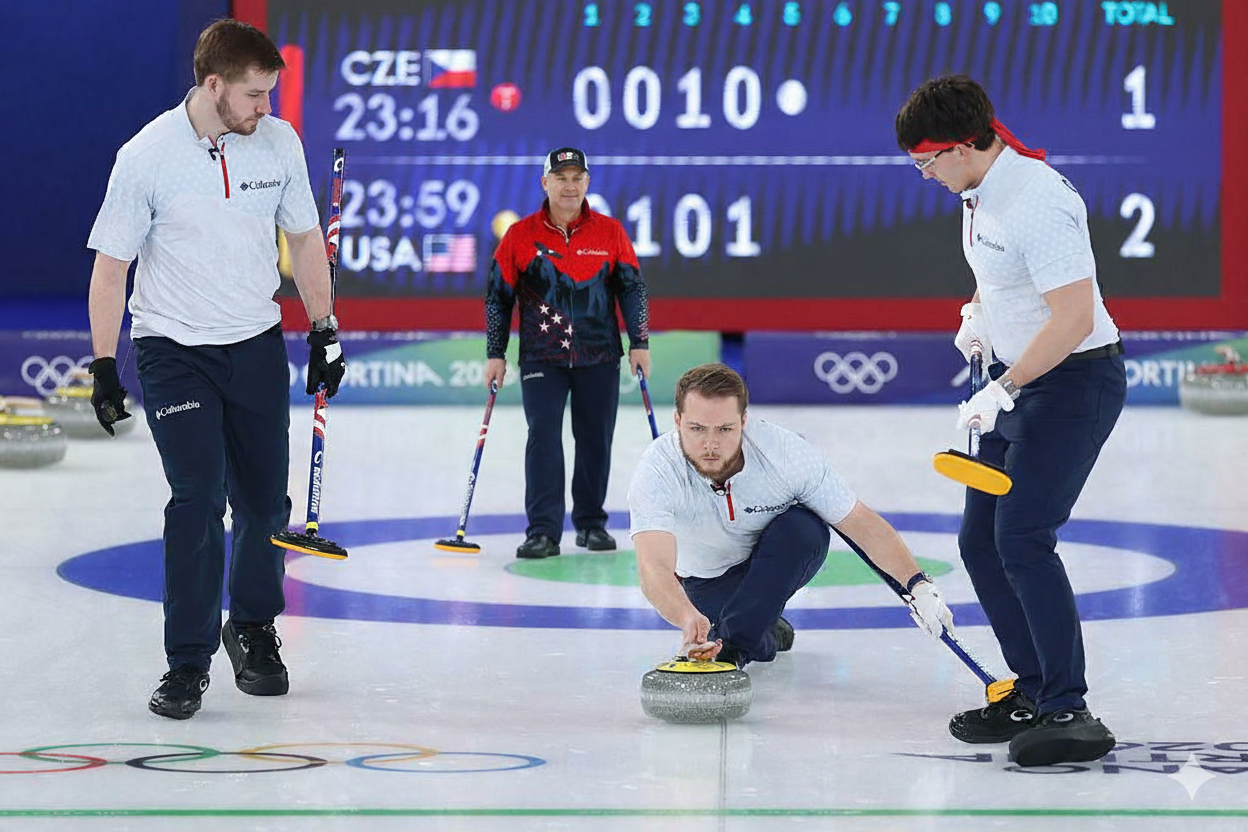

At the 2026 Winter Olympics in Milan-Cortina, history was quietly made on the curling sheet. Rich Ruohonen, a 54-year-old injury lawyer from Minnesota, became the oldest American ever to compete at a Winter Olympics.
While the U.S. men’s curling team trailed Switzerland 8-2, the stakes in the match were low — but the moment was monumental. Ruohonen stepped onto Olympic ice for one end, cementing his place in U.S. sports history.
Injury Lawyer Turned Olympic Trailblazer
Ruohonen is not just an Olympian — he is a respected injury lawyer and six-time winner of Minnesota Attorney of the Year. Balancing courtroom responsibilities with elite-level athletic preparation, he has become a symbol of dedication and perseverance.
When the substitution was made late in the match against Switzerland, Ruohonen delivered a steady corner guard and helped the Americans score one final point before conceding an 8-3 loss.
“It’s awesome. It’s hard to do it in that situation when we’re getting beat,” Ruohonen said. “I would have rather done it when we were up 8-2 instead of down 8-2. I really appreciate the guys giving me a chance.”
With that appearance, he surpassed Joseph Savage, who was 52 when he competed in pairs skating at the 1932 Games, as the oldest U.S. Winter Olympian. The oldest American ever to compete in any Olympics remains Thomas Scott, who was 71 at the 1904 St. Louis Games.
From Minnesota Courtrooms to Olympic Ice
Ruohonen serves as the alternate for skip Danny Casper’s team. The squad earned its Olympic berth after defeating five-time Olympian John Shuster at U.S. trials and then winning a last-chance qualifier.
Despite being three decades older than Casper — who was born in 2001 — Ruohonen has become the team’s mentor, driver, and unofficial “uncle.”
Casper jokingly reminded reporters multiple times:
“We got Rich. Uh, he’s a lawyer. I don’t know if you guys knew that.”
The younger teammates often tease him, but their respect is evident. Ruohonen represents a bridge between curling’s old-school roots and its modern, high-performance approach.
The Grueling Routine of an Injury Lawyer Olympian
Being an injury lawyer is already demanding. Combining that with Olympic training requires extraordinary discipline.
Ruohonen’s weekly schedule includes:
- Waking up at 5 a.m. three days a week
- Driving 30 miles to train
- Working a full day at his law practice
- Evening practice sessions
- Traveling Thursday through Sunday for tournaments
- Handling legal hearings over Zoom while on the road
He carries a collared shirt and tie in his curling bag to switch instantly from athlete to attorney.
“I came from the days when guys were smoking cigarettes out on the ice,” Ruohonen joked. “Look at these guys. Every one of them’s ripped. And every one of them sweeps their butt off.”
A Record That Reflects Longevity and Passion
The historic appearance came at the 2026 Winter Olympics, hosted in Milan and Cortina d’Ampezzo, Italy.
While the moment lasted just one end, it symbolized:
- Dedication over decades
- Perseverance after near-misses
- The evolving professionalism of U.S. curling
- The possibility of balancing elite sports with a full-time career
Ruohonen had narrowly missed Olympic qualification in previous cycles. His inclusion in 2026 fulfilled a lifelong dream — even if it came in a late-game substitution.
Family, Mentorship, and Legacy
Ruohonen and his wife Sherri have two children, Nicholas (21) and Hannah (24). He taught both to curl, just as his father taught him. Though Nicholas prefers hockey, the family connection to the sport remains strong.
Beyond statistics, Ruohonen’s presence has added stability to a young team. He provides logistical help, emotional support, and decades of experience — a rare combination in modern Olympic sport.
His journey also highlights something unique about curling: unlike many Olympic disciplines dominated by teenage prodigies, curling allows athletes to compete at the highest level well into their 40s and 50s.
Why This Story Resonates Beyond Sports
The story of an injury lawyer competing at the Olympics resonates because it challenges stereotypes.
Elite Olympians are often portrayed as full-time athletes from adolescence. Ruohonen proves that:
- Professional careers and Olympic dreams can coexist.
- Age is not always a barrier in skill-based sports.
- Dedication over decades can eventually be rewarded.
For aspiring athletes, working professionals, and even fellow injury lawyers, his achievement is a reminder that long-term commitment matters.
Conclusion: A Moment That Will Be Remembered
Rich Ruohonen may have played just one end in an 8-3 loss, but his impact goes far beyond the scoreboard.
At 54, this Minnesota injury lawyer stepped onto Olympic ice and made history. He became the oldest American Winter Olympian, inspired teammates half his age, and demonstrated that perseverance can outlast setbacks.
In the end, it wasn’t about winning that match. It was about fulfilling a dream — and showing that even from the courtroom to the curling rink, excellence knows no age limit.

 By
By


 By
By