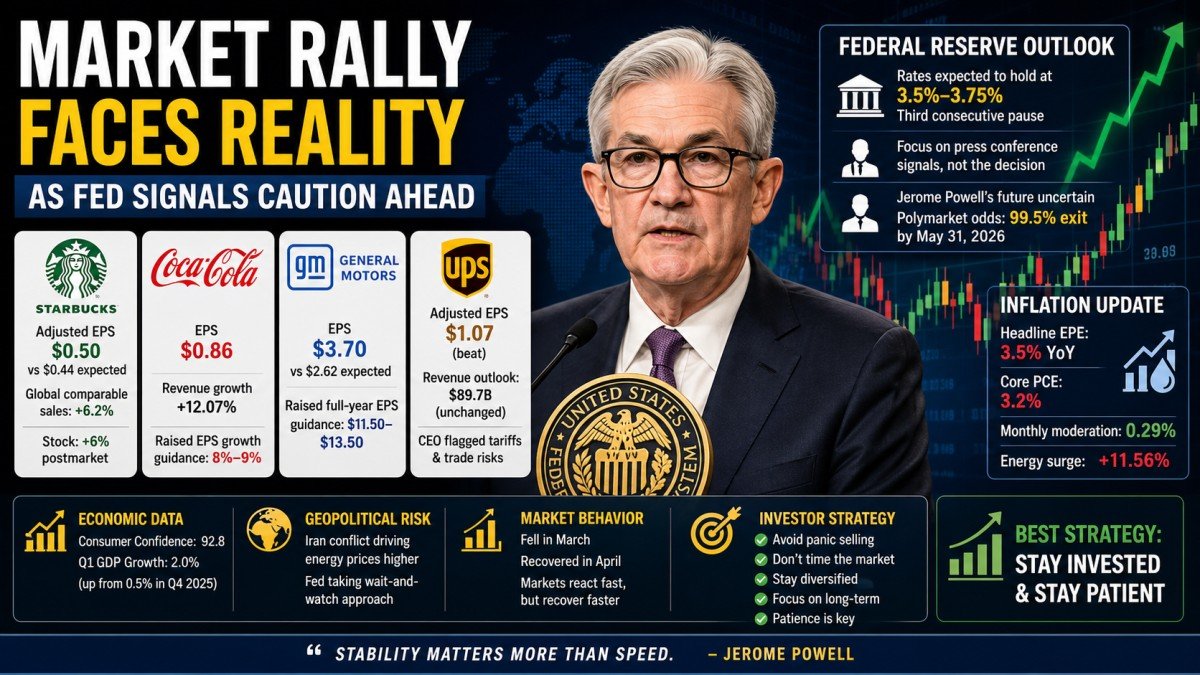
Market Rally Faces Reality as Fed Signals Caution
Global financial markets in 2026 are navigating a complex environment shaped by strong corporate earnings, persistent inflation, and geopolitical uncertainty. While recent earnings reports from major companies have exceeded expectations, the broader outlook remains cautious as policymakers and investors weigh future risks.
The Federal Reserve continues to play a central role in shaping market direction. With interest rates expected to remain in the 3.5%–3.75% range for the third consecutive meeting, the focus has shifted from policy decisions to forward guidance. Investors are closely watching signals from Fed Chair Jerome Powell, as his tone is likely to influence market sentiment more than the rate decision itself.
Strong Earnings, But Limited Confidence
Corporate earnings have been a bright spot. Companies like Starbucks reported adjusted EPS of $0.50, beating expectations, with global comparable sales rising 6.2%. Similarly, Coca-Cola posted solid results with $0.86 EPS and over 12% revenue growth, even raising its guidance.
General Motors also delivered strong performance, exceeding estimates and increasing full-year guidance. Meanwhile, United Parcel Service beat earnings expectations but maintained a cautious revenue outlook due to trade and tariff concerns.
However, despite strong results, most companies are not significantly raising future guidance. This suggests underlying uncertainty driven by inflation, rising energy costs, and geopolitical risks.
Inflation Remains a Key Concern
Inflation continues to challenge policymakers. The latest data shows headline PCE inflation at 3.5% year-over-year, while core PCE stands at 3.2%. Although core inflation is gradually cooling, rising energy prices—up over 11%—are keeping overall inflation elevated.
This mixed trend complicates the Fed’s strategy. While there are signs of progress, inflation remains above target, limiting the possibility of aggressive rate cuts in the near term.
Economic Growth Shows Resilience
Despite these concerns, the broader economy is showing strength. Consumer confidence has risen to 92.8, beating expectations, while GDP growth for Q1 2026 reached 2.0%, up from 0.5% in the previous quarter.
These indicators suggest that the economy remains resilient. However, strong growth also supports the case for keeping interest rates higher for longer, adding another layer of complexity for investors.
Geopolitical Risks Add Pressure
Global tensions, particularly in the Middle East, are contributing to market uncertainty. Rising energy prices and potential supply disruptions are key concerns. The Federal Reserve has acknowledged these risks and is taking a cautious, wait-and-watch approach.
Market Volatility and Investor Strategy
Markets have shown significant volatility in recent months, falling in March and recovering in April as tensions eased. This highlights how quickly sentiment can shift based on news and global developments.
Financial firms like Charles Schwab have warned investors to remain cautious, noting that much of the Fed’s policy stance is already priced into the market. Future movements will depend heavily on subtle changes in messaging.
Key Takeaways for Investors
- Strong earnings do not guarantee future growth
- Inflation remains above target levels
- Federal Reserve policy is cautious and data-driven
- Geopolitical risks continue to influence markets
- Volatility is likely in the short term
Conclusion
The current market environment reflects a balance between optimism and caution. While economic growth and corporate earnings remain strong, persistent inflation and global uncertainties limit upside potential.
Investors should focus on long-term strategies, diversification, and disciplined decision-making. As emphasized by Jerome Powell, stability remains the priority, and patience is essential in navigating today’s financial landscape.
Disclaimer
This article is for informational purposes only and does not constitute financial or investment advice. Market conditions can change rapidly, and past performance is not indicative of future results. Always conduct your own research or consult a qualified financial advisor before making investment decisions. Investing involves risk, including potential loss of capital.